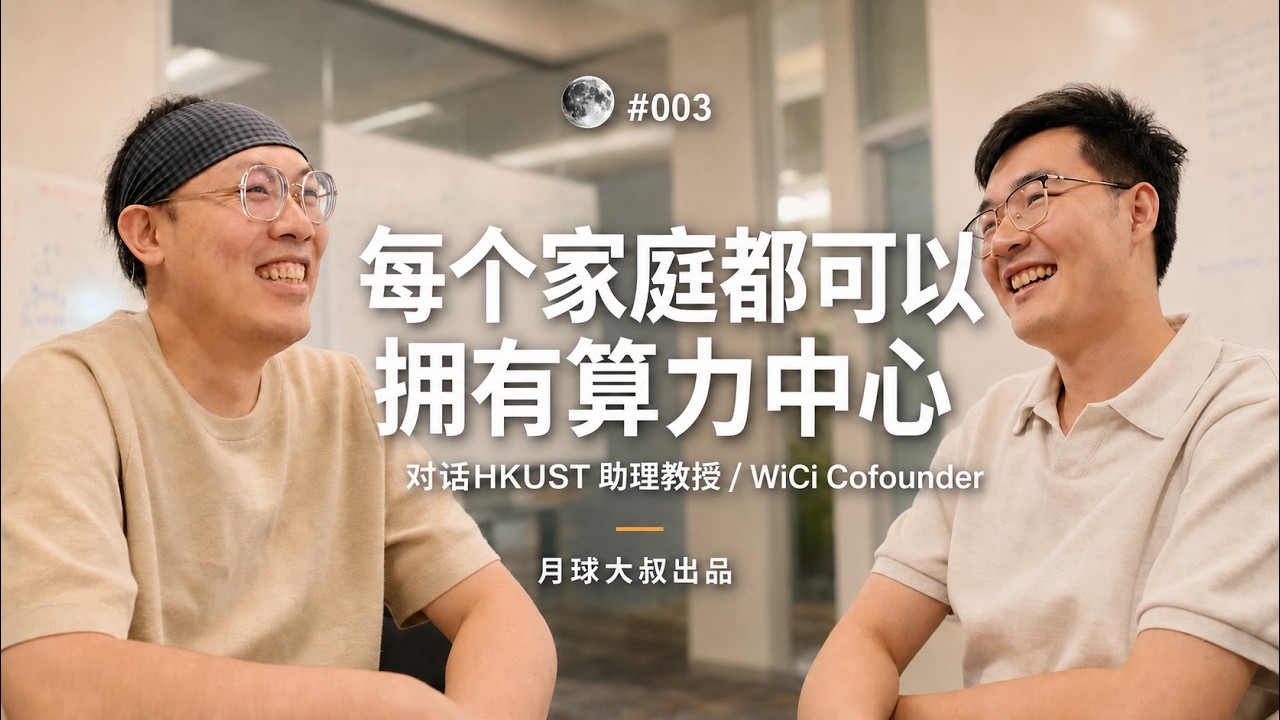
Zili Meng, HKUST's youngest assistant professor and WiCi co-founder, on timing, research taste, and why your next GPU might live in a router
Zili Meng is an assistant professor at HKUST (The Hong Kong University of Science and Technology), where he leads the Streaming Platform and Real-time networK (SPARK) Lab working on networking, ultra-low-latency video, and real-time communication. He entered Tsinghua at 15, earned both his B.Eng. and Ph.D. there in computer networking, and joined the HKUST faculty at 23.
He co-founded WiCi, a startup building a wireless GPU—a router-like box that lets any nearby device use a top-tier GPU over Wi-Fi as if it were local. The longer ambition is wireless computing infrastructure: instead of forcing every robot, wearable, or mobile device to carry its own high-end accelerator, make powerful compute available as easily as a Wi-Fi connection. Before WiCi, he built xg.glass, a universal SDK for developing AI glasses applications. He also developed CallArena, a benchmark for real-time video calls with AI models.
In our in-depth conversation, we discuss:
- How he got into Tsinghua at 15—and why he insists it wasn't talent
- Applying reinforcement learning to networking at MIT in 2017, and why being early mattered more than being brilliant
- Why he stayed at Tsinghua for his PhD instead of going to the US
- How he became HKUST's youngest assistant professor at 23
- What AI changes—and doesn't—about systems engineering
- WiCi's bet: intercepting GPU calls at the driver level, offloading them one Wi-Fi hop away, and making a MacBook believe it has a local RTX 5090
- How a wireless GPU could unlock more capable robots, wearables, and personal agents
- What a professor learned from building a hardware supply chain from scratch
My biggest takeaways from this conversation:
-
Timing is crucial.
As an undergrad at MIT in 2017, Zili worked on some of the earliest applications of reinforcement learning to networking. The reason it worked, he recalled: networking was a year or two behind AI, so the play was to port proven techniques (A3C, PPO) across the gap. The algorithms didn't just work out of the box: the bulk of the work was fixing what broke on a real cluster. Plenty of it was unglamorous, but doing it before everyone else made it count. "Your insight and your sense of timing can often be far more important than simply working hard."
-
What survives AI in systems research is storytelling and research taste.
The field's traditional moat, such as kernel code, driver code, and a brutally steep learning curve, is losing its value to AI coding tools, the same way assembly gave way to higher-level languages. What survives is the ability to define a problem where no benchmark exists, and to sense which approach will work before you've built anything. His own bar for students has changed every year: in 2023, joining his lab required having written a 1,000-line project; two years later he cares far less about whether you can write the code and far more about whether you have the intuition to know what's worth writing.
-
Why he chose Tsinghua over a US PhD.
In 2018, Zili chose Tsinghua over a US PhD: applying meant ~6 months of GRE prep pulled from research already underway, while the benefit—after a summer at MIT to check for himself—was real but small. Years later he carries a little regret: a new institution buys you a new alumni network, and "as a student, it's difficult to appreciate that."
-
PhD is not just one project; it is a collection of different projects and experiences.
Of his four PhD years, perhaps only a year was spent at Tsinghua itself—the rest went to a year inside Tencent's cloud-gaming team, six months at Alibaba, several months at a startup, and a year at CMU. "For a paper, if something works in one case, you can say it works; in production, no corner case can break it." His advice: a PhD is your last chance to try things with a safety net—whatever you experiment with, you still walk away with the degree.
-
WiCi moves the compute, not the experience.
Cloud gaming, cloud PCs, and cloud phones all run both frontend and backend remotely and ship video back over a best-effort Internet that can't guarantee the reliability the experience needs. WiCi inverts this: the application stays local and never knows anything changed; the system intercepts compute calls at the driver level and executes them on a router-like box one Wi-Fi hop away. To your MacBook Air, it simply looks like the machine has an RTX 5090 inside. The physics is simple: top GPUs are the size, weight, and power draw of a small appliance—no phone, laptop, or pair of glasses will ever fit one, and the gap only widens with every GPU generation. If the best compute can never live in the device, put it one Wi-Fi hop away.
-
Replacing PCIe with Wi-Fi revives a computer-architecture problem that fast interconnects largely buried two decades ago.
A GPU normally talks to a CPU over PCIe, a link built to be fast and instant. Wi-Fi is the opposite on both counts: it moves data far more slowly, and each round trip takes far longer. WiCi's answer is to treat this not as a networking problem but as an architecture problem: "We essentially defined a new computer architecture. The CPU and GPU communicate over a weak link rather than a strong one." Before PCIe, slow links between chips were normal, and architects worked around them with caching, prediction, and scheduling. Wi-Fi brings the slow link back, and the same toolbox applies.
-
The next local-compute wave is agents working on non-text files.
Coding agents took off first partly because code is grep-able plain text. The moment agents actually open everything else on your disk, local compute demand explodes. Robots are the same story: a Jetson-class onboard chip can't match a desktop GPU, but a robot that offloads its brain over one wireless hop can. WiCi's long-term ambition is in its name—the "Ci" replaces Wi-Fi's "Fi" with Computing Infrastructure: a compute router in millions of homes.
-
A long list of use cases is not a market.
Once compute is available over Wi-Fi, use cases are everywhere—supermarket robots, delivery robots, smart carts, video editing, glasses. However, "many scenarios don't mean customers are willing to pay". The long-term ambition is consumer infrastructure—a box in every home. But he's starting much smaller, with the few users who already know why they need local compute: video editors, tech enthusiasts, small studios.
-
Own one layer; outsource everything else.
WiCi touches GPU drivers, Wi-Fi drivers, inference, hardware, and applications, and a startup can't build all of it. Zili keeps the company focused on the low-level driver and inference stack—"our greatest technical moat." Hardware goes to ODM (Original Design Manufacturer) partners, and applications go to robotics developers, who know their own users better than WiCi ever could. In the short term he believes performance is everything: rivals can copy the hardware but not years of systems expertise. Long term, the moat is the ecosystem: "I don't think you can deliberately manufacture an ecosystem. It emerges only when people find something useful."
-
For a hardware startup, the supply chain teaches the hardest lesson.
Zili's biggest difficulty was volume: a startup ordering a handful of units is a customer no supplier needs to take seriously. The normal route—walk in, negotiate, place an order—was closed, so the supply chain had to be assembled through connections instead: "friends, relatives, and their referrals." His biggest pitfall: GPU price volatility. When your product contains an RTX 5090 and Nvidia reprices, your margins move; in hindsight, he says, they should have stockpiled units and signed long-term agreements.
-
Have the courage to ask, and keep the ego small.
In his first two years as a professor, Zili wrote twenty grant proposals and got one accepted. His conclusion: "You have to swallow your pride and ask people for help. If you don't ask, no one will volunteer." The supply chain, the co-founders, the early partners—all came from asking.