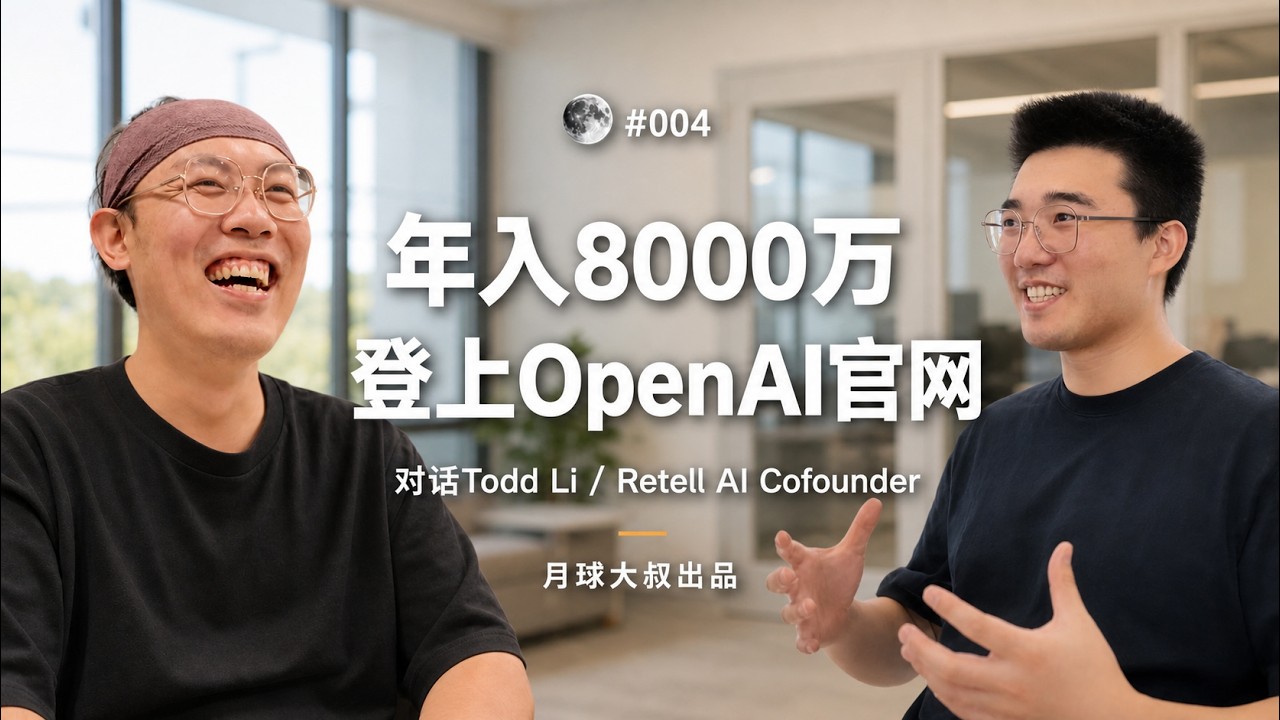
Todd Li, co-founder and President of Retell AI, on declining startup money from his parents, taking voice agents from demo to production, and how a 50-person company competes with OpenAI.
Todd Li is co-founder and President of Retell AI, where he runs operations — finance, recruiting, customer success, legal, compliance, and IT. He is a second-generation entrepreneur: his father founded a company around the time Todd was born and later took it public. In 2022, Li joined Google's ads team as an engineer, building the algorithms that decide which ads get Google's traffic. For years, he built side projects in his spare time, and nearly all of them failed. His team's TOEFL essay-grading app got them a Y Combinator interview, but YC did not think the business idea would work. Their second application, with live-stream translation software, got them in. YC requires founders to work full-time, so he left Google in January 2024. Retell AI did not yet exist, and the team was still searching for a viable product and market.
Retell AI builds voice agents that handle customer-support, sales, and collections calls for B2C companies. Those calls would otherwise be handled by call centers with thousands of human agents. Mentored at YC by Michael Seibel (co-founder of Twitch), the five co-founders explored accent removal and text-to-speech before building the agent itself. In the conversation, Li puts the company at about $80 million in annual revenue two years in, with more than 3,000 customers, including OpenTable, Opendoor, Mercury, Anker, Lenovo, and CVS. The long-term ambition is to support both AI and human agents across the full call workflow, then provide the CRM for companies whose primary channel is the phone.
In our in-depth conversation, we discuss:
- Turning down startup money from his parents: Silicon Valley is short on founders, not capital
- Two YC applications: why YC rejected the TOEFL essay-grading idea, then offered to admit the team and help them find a new direction
- How a new technology typically opens a two- or three-year window for startups, and why the team tested voice ideas in quick succession
- Why voice is harder to deploy than text, and how Retell competes with one OpenAI team
- After pivoting to the voice agent, they got tens of thousands of users in the first week — earlier products had a month of marketing and almost no users
- How Retell's five founders used YC's $500,000 and $900,000 in cloud credits, hiring no engineer until the company reached $3 million in annual revenue
- The advice they fought Seibel on — hire as few people as possible, go enterprise early — kept turning out right
- Five co-founders with equal equity, and why Li would rather start a company with friends
- What it took to win CVS, and why replacing an enterprise contact center can take nearly a year after signing
My biggest takeaways from this conversation:
-
Li declined startup money from his parents: Silicon Valley is short on founders, not capital.
His parents had set aside startup capital and asked whether he would take it. He said no: "Because Silicon Valley never lacks money. What it lacks are capable founders." To illustrate, Li imagines an ordinary person with Elon Musk's memories but no money or network. He believes that person could build something huge within a few years. "I think money, resources, and connections are ultimately a reflection of a person's abilities."
-
Success = resources × execution × luck, and execution is the only factor a young founder controls.
Li heard the formula from other founders. Luck is beyond a founder's control, and early on, resources depend on other people. Execution is in the founder's own hands. Execute well, he says, and people will come to help. YC's response to his team illustrated the same point. In their first interview, YC asked whether they had any other ideas. In the second, they presented live-stream translation software with an eight-second delay. Seibel told them: "This idea doesn't work. But you've built the product well, and the team is strong. Would you be willing to join YC first, then consider pivoting to another idea?" All five quit their jobs to work full-time while still searching for a viable product and market.
-
A new technology typically opens a two- or three-year window for startups.
After ChatGPT took off, the team studied the patterns that followed the emergence of the internet, mobile technology, and cloud computing. "After a new technology appears, its window of opportunity usually lasts only two or three years. Most companies that ultimately succeed are founded during that window." They were racing to find a product that customers wanted, testing different ideas as quickly as they could. Li is skeptical about founders entering voice AI now: "I think they probably won't succeed, because there are already many competitors." He believes competition from both startups and giants makes customers very hard to win.
-
Don't build tools around the call — build the AI that answers it.
At YC, the five founders pitched Seibel ideas for voice products. One would remove call-center workers' accents, but it would become unnecessary if AI replaced human agents. They also considered text-to-speech, but their goal was still to replace human customer-service agents with AI. "So we might as well go directly to the deepest layer, the layer closest to the customer." Earlier products had attracted almost no customers after a month of marketing. The voice agent attracted tens of thousands of users in its first week. The team announced it across multiple platforms. After Garry Tan and Paul Graham shared the posts, traffic overwhelmed the servers. "I think marketing only works when you have a good product worth marketing."
-
Startups can win in areas the giants do not prioritize: Retell's whole company competes with one OpenAI team in voice.
OpenAI, Anthropic, and ElevenLabs all build voice or customer-service products. Li argues that a team inside a large company cannot match the focus and expertise of a company devoted entirely to voice. OpenAI's voice work falls under one director, he says: "It's our entire company against one team under that director." Competing on models or coding agents, which he calls OpenAI's second-biggest area, would be different: "We couldn't beat them. Voice just isn't that big a priority for them." Customers choose Retell after testing the products, he says. It cannot match OpenAI's name recognition, so it has to win on product performance.
-
A voice demo is easy; production is hard. Three years in, most teams building voice AI still only have a demo.
The difficulty lies in making a voice agent work in production. Text-based customer service can give the model, knowledge base, and other components ten seconds or more to compute. Voice lacks that buffer, so inference, servers, and connections need to be adapted for real-time conversation. As Li notes, "everyone can build an impressive demo" by recording an AI phone call and posting it online. Replacing a company's call center exposes problems that never surface in a demo. As he puts it, "The real challenge is going from demo to production." Three years in, he says most teams trying to build voice AI still only have a demo.
-
Seibel pushed them to sell to enterprises early: enterprise customers are harder to land but stickier once you're in.
Small and mid-sized businesses adopt early, but retention is weaker and the contracts are smaller. "Enterprise customers are stickier. They're harder to land, but once you're in, retention is stronger, and net dollar retention is better." Winning larger customers is a gradual process. Small customers provide validation that helps attract mid-sized customers, who in turn help attract enterprises. Mid-sized customers may also conduct due diligence on Retell and ask about SOC 2 compliance. The shift is painful: small customers praise you, while enterprises may barely respond as you try to win their business. "That goes against human nature." CVS, America's largest pharmacy retailer, took considerable time to win. Meeting enterprise compliance requirements even meant installing an office access-control system. More broadly, Li says replacing an enterprise customer's contact center can take nearly a year after signing.
-
A startup's growth is limited by its founders' abilities; more money and more hires cannot make up for that.
Seibel kept giving advice the team strongly disagreed with, and he kept turning out to be right. He urged them to keep hiring to a minimum. He also warned that "in some ways, too many customers and too much money can be toxic." Li imagines five new founders given $500 million: they hire a hundred salespeople and a hundred engineers. But a first-time founder probably does not know how to hire great people, and the wrong hires will not build a great product. In Li's view, the founder has to be the company's strongest person overall to attract exceptional people: "You can't hire Jensen Huang to work for you." Retell's five founders started with YC's $500,000 and $900,000 in cloud credits from Amazon, Google Cloud, and Azure. They did not hire their first engineer until Retell reached $3 million in annual revenue.
-
Splitting equity equally among five co-founders works with human nature, not against it.
Two co-founders run go-to-market, two run product and engineering, and Li runs operations. Three attended USC, and the other two were colleagues. They may have been the YC team with the most co-founders. Li agrees with YC's recommendation to split equity equally: "If one founder owns 10% and another owns 40%, we have to be realistic about human nature. Over time, problems will emerge." Co-founders also challenge one another's decisions. Each person naturally believes they are the smartest and hardest-working, and a founder whose decisions no one challenges is more likely to go down the wrong path. Friends already trust one another, so they are less likely to take disagreements personally. "If, at the start of a company, you still have to slowly build trust with your own co-founder, that company will have a hard time succeeding."
-
Hire for the job that actually needs to be done, and pay enough that success means financial freedom.
Retell's interviews use practical coding, never LeetCode, so candidates without prep time can still pass. Promising candidates with mixed interview results can spend a week working with the team, taking leave from their current job. Li admits he still sometimes gets the assessment order wrong: "We shouldn't assess skills first, talent second, and culture last. It should be the other way around." Retell also invests heavily in recruiting. Of its 50 full-time employees and 50 contractors, twelve work on hiring. Li says pay is probably higher than at Meta or Google for comparable roles. The company aims to pay in the market's top 5%, with $70 a day in DoorDash credits and $300 a month each for commuting and wellness. He explains the goal: "If the company has a successful exit, whether through an IPO or another path, we want everyone to achieve financial freedom." Li adds that he would feel deeply guilty if he achieved financial freedom but his employees did not.